

Knowing when to trim live oaks in Central Texas is a scheduling problem before it’s a cutting problem, and the reason has nothing to do with the tree.
Oak wilt is treated as an epidemic across this region by the Texas A&M Forest Service. The fungus moves between trees on beetles that are drawn to fresh wounds. Live oak timing exists because of that beetle.
The Safe Pruning Window
The safe pruning window rules out February through June.
That’s the stretch when the beetles are most active and a fresh cut is most likely to be found, so nobody in this region prunes an oak through spring. Homeowners wait. Crews wait. Arborists wait.
A company willing to cut your oak in April is telling you something about itself.
Sealed cuts are the other half, and on an oak they aren’t optional. Every wound gets painted immediately, in the same minute the saw leaves the wood, including wounds nobody planned. A limb torn off in a storm counts. So does a scrape from a mower deck or a fence post going in.
Not Every Tree Follows the Same Calendar
Oaks get the strictest rule, but they aren’t the only tree in a Central Texas yard.
| Tree | When |
|---|---|
| Live oak | Never February through June |
| Post oak | Same oak wilt rules |
| Cedar elm | Dormant season is best |
| Pecan | Late winter, before budbreak |
| Crape myrtle | Late winter, and never topped |
| Storm damage | Any day it happens, sealed immediately |
What the Work Actually Is
Once the window opens, oak work is about structure and clearance rather than shaping. A live oak doesn’t need a haircut. It needs decisions.
Deadwood removal comes first. It’s the safest work on any tree, dead limbs come out whether the rest of the tree needs anything or not, because they’re what falls on a car in the next storm, and taking them removes nothing living.
Clearance pruning is what most people actually called about. Limbs off a roof line, away from a drive, above a walkway. It’s usually a handful of cuts rather than the canopy reduction they were bracing for.
Crown thinning opens the canopy so light and air move through without removing the tree’s outline. Topping a live oak to bring its height down is a different act entirely, and it leaves a tree weaker, uglier and more likely to fail in wind.
Structural pruning on a young tree costs a few cuts and prevents a split trunk twenty years later. Limb removal at the right stage prevents the kind of work nobody wants to pay for later, and almost nobody does it on schedule.
Every oak cut is painted as it’s made. Brush goes through the wood chipper and off the property rather than into a pile that stays wet by the fence.
Mistakes Worth Avoiding
- Trimming an oak anywhere in the spring
- Leaving any oak wound unsealed, planned or not
- Topping a tree to reduce its height
- Taking too much canopy in one visit
- Flush cuts hard against the trunk
- Moving tools between oak trees without cleaning them
Did you know?
A row of live oaks along one street can graft together underground into something closer to a single organism than separate trees. It’s also how oak wilt travels house to house with no beetle involved at all.
Trimming Live Oaks in Texas, Answered
Almost every question about oaks in this region is really a question about oak wilt and timing. These come up before any saw gets scheduled.
When is it safe to trim a live oak here?
Outside February through June. That window is when the beetles carrying oak wilt are most active and most likely to find a fresh cut. July through January is the working season, and mid-winter is the safest stretch of it.
What if a limb breaks during the spring?
Seal it immediately. Storm damage doesn’t wait for a calendar, and an unsealed break in April is exactly the wound the beetle is looking for. Paint it the same day, then handle any real pruning later in the year.
Does the wound paint really make a difference?
On oaks in this region, yes. The Texas A&M Forest Service position is to paint every oak wound immediately, and immediately means minutes, not hours.
Can you take the height off my live oak?
Not by topping it. Reducing a mature oak’s height means removing the structure holding it up, and the regrowth that follows is weakly attached. Thinning and clearance work solve most of what people are actually asking for.
Who’s actually doing the work on my tree?
Tree work here is guided by owner AJ Liles, an ISA Certified Arborist, TX-377705A. That’s an individual credential earned by a person, not something a company holds, worth knowing when you’re comparing bids.
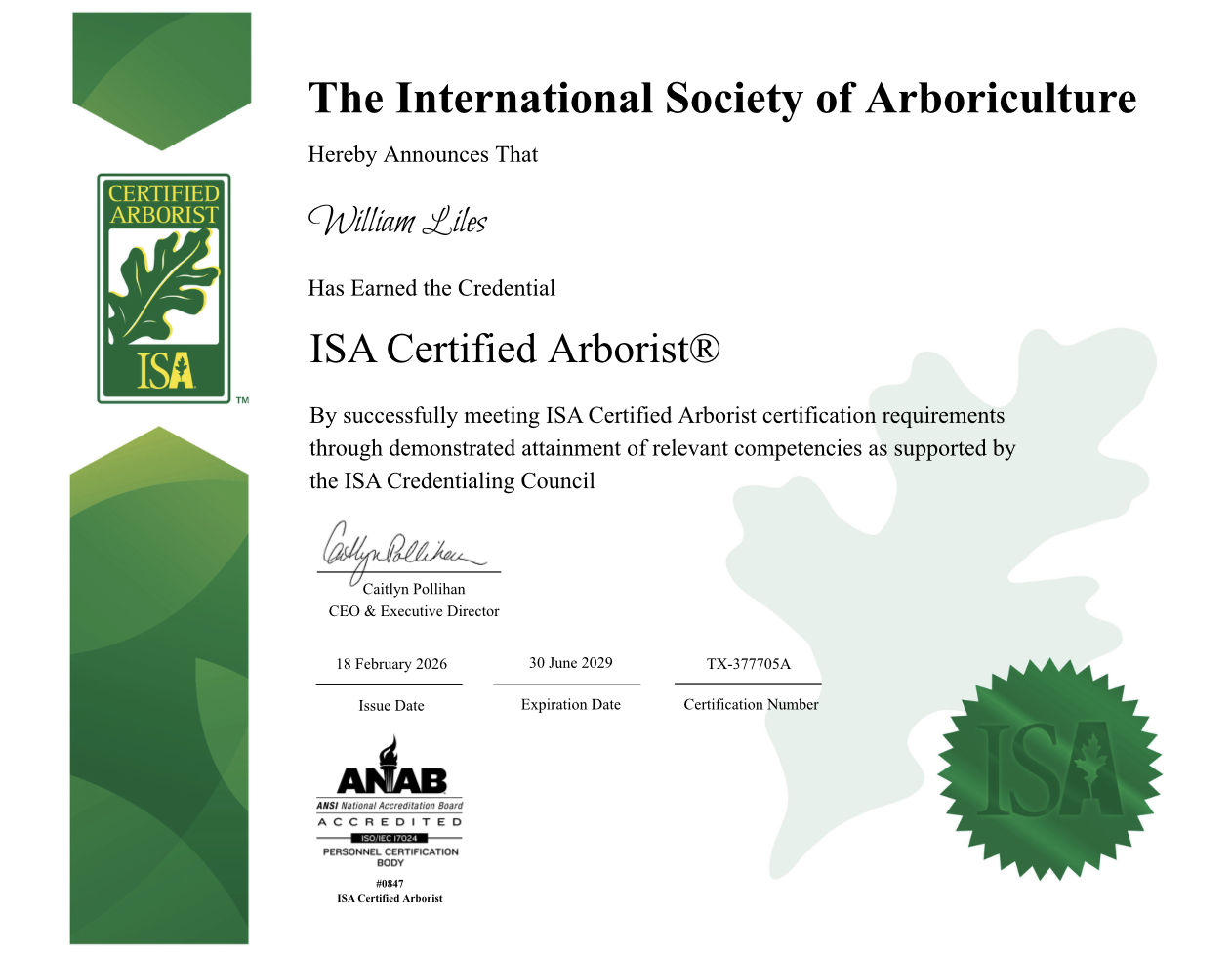
Authored by William “AJ” Liles, ISA Certified Arborist TX-377705A, TCEQ Licensed Irrigator LI0022271